All Humans are Family
Earth is Our Mother


A Thought for the Day
10. Believe in truth: Abandoning truth means abandoning freedom; if nothing is true, then power is all that matters.
11. Investigate: Read long-form journalism, prioritize primary sources, and figure things out for yourself.
My Comment: Self determination is the core freedom from which all other freedoms proceed. Self determination is the process of sensing and apprehending the Truth and authentic morality for oneself. Allowing other authorities, such as the Church, or political leaders or even AI to determine your Truth for you reduces you to little more than the status of a slave. Critical thinking is an essential part of being truly free.
Posted October 17, 2026


Dungeness River Flow Status
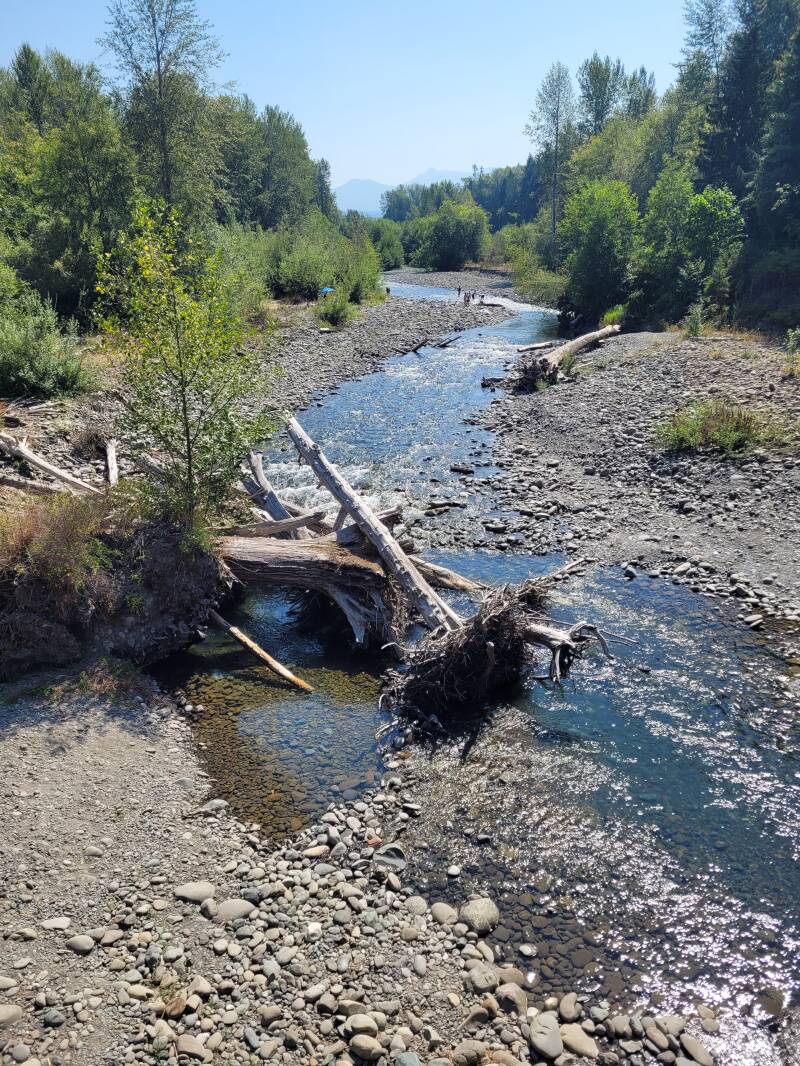
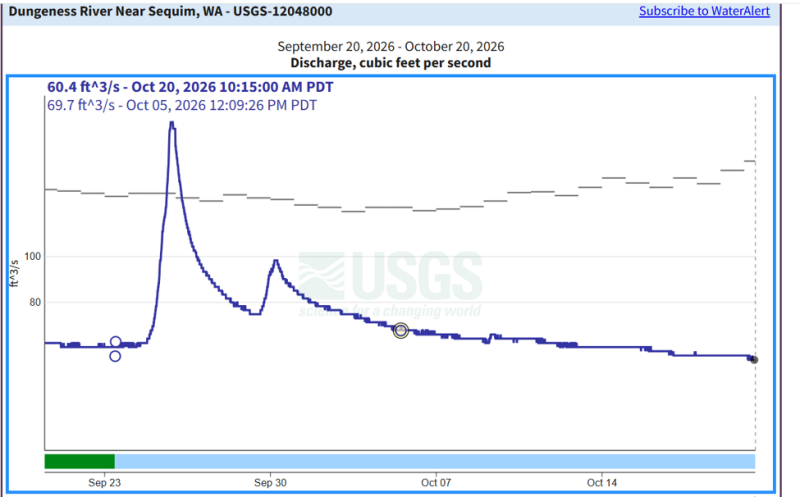
The Dungeness River is now setting new record low levels. Early this morning, the flow level dropped below 60cfs. This is the lowest river flow in its recorded history. The fall rainy season may be approaching. But the effects of the current strong EL Nino are not encouraging.

Updated October 23, 2026

ASSURING OUR WATER FUTURE
Posted October 22, 2026
Executive Summary:
The Problem
- The availability of water in our Sequim-Dungeness area is becoming an important concern and cannot be taken for granted anymore.
- We are now well into an era of climate change which is giving us warmer and drier winters, less snowpack and increasingly lower river levels in the summertime.
- The WA State Department of Ecology is aware of this and has undertaken the Washington's Water Futures Initiative to explore the problem and find ways of mitigating our future water shortages.
- The water flows in the Dungeness River are undergoing major changes: less snowpack and higher runoff in the winter and increasingly lower water runoff in the summer.
- Our local aquifers are being adversely affected. Reports are indicating that water levels in our local aquifers are dropping. Shallow wells are drying up and are being deepened.
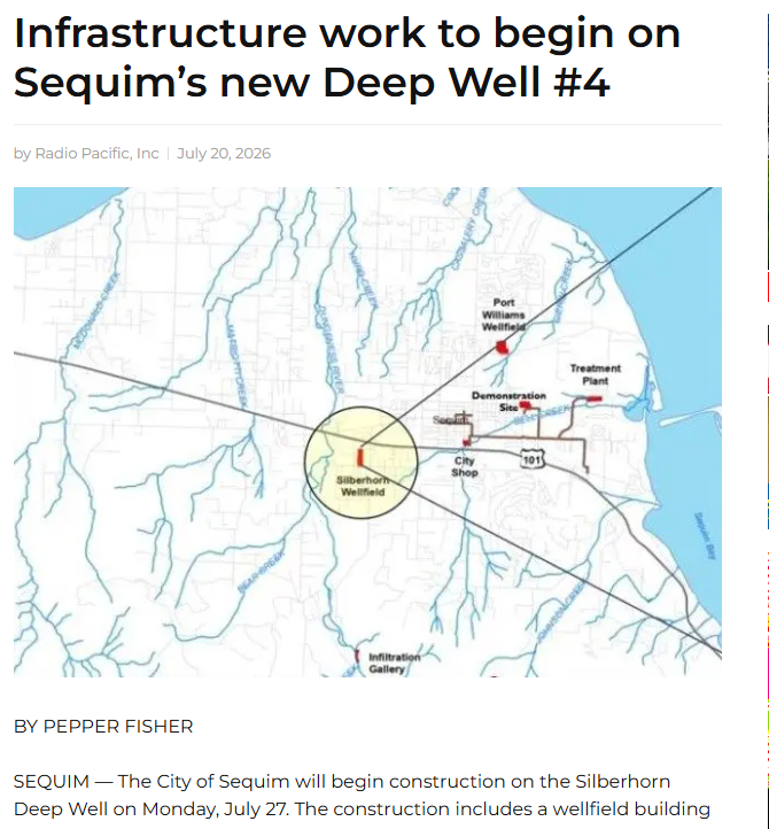
- The city of Sequim is hedging its bets by drilling and installing a new deep well in the Silberhorn Well Field west of River Road.
The Solution
- Collect more data on the trends in the aquifer in the Sequim-Dungeness watershed.
- Begin the process of aquifer recharge as soon as practical.
- The city of Tucson, AZ, in the Sonoran Desert has mastered the task of aquifer recharge, offering us an example.
- The local area has an extensive area of irrigation ditches and pipelines which may offer a significant resource for potential aquifer recharge.
- The local watershed has a number of areas of open water which might serve as potential recharge basins.
It's time to face the reality of our declining water resources that affects us all. Instead of looking for barriers, let's believe in and work for solutions. By working together as a community, we can find and implement potential solutions and assure our water future.
Introduction
The availability of water in the Dungeness basin and the Sequim area of becoming an important concern and cannot be taken for granted anymore. Sequim enjoys the reputation of being in the center of the “Rain Shadow” of the Olympic Mountains. The town enjoys a mild relatively dry sunny climate in the middle of the otherwise wet Olympic Peninsula. This is becoming a problem in this era of increasing climate change.
Climate Change
Our planet is well into a new era of serious climate change. All around the planet we are witnessing extreme weather such as excessive heat, drought, flooding and melting of glacial ice. The recent disaster in Nepal is just such an example. The upper Olympic Peninsula is one of the most climate resilient areas in the country, and this fact is attracting an increasing number of climate refugees, seeking to escape excessive heat, forest fires and dangerous flooding.
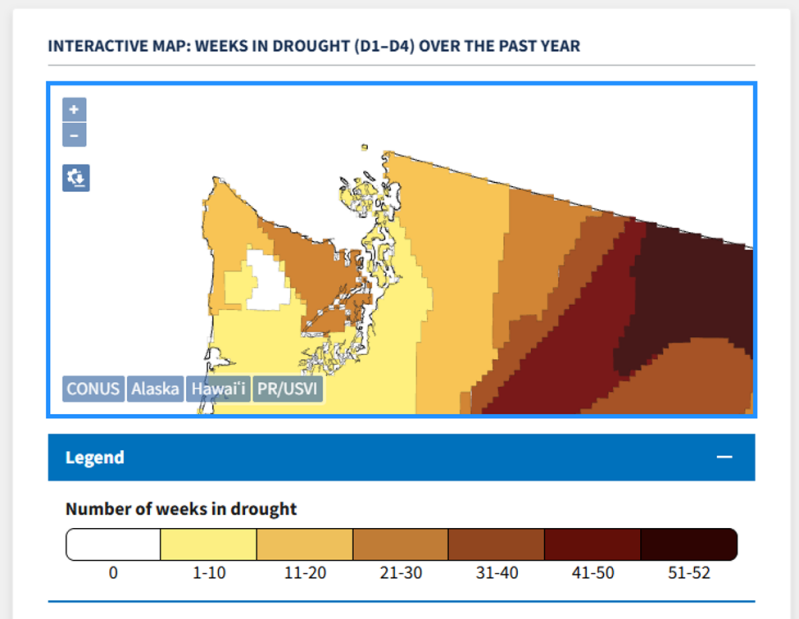
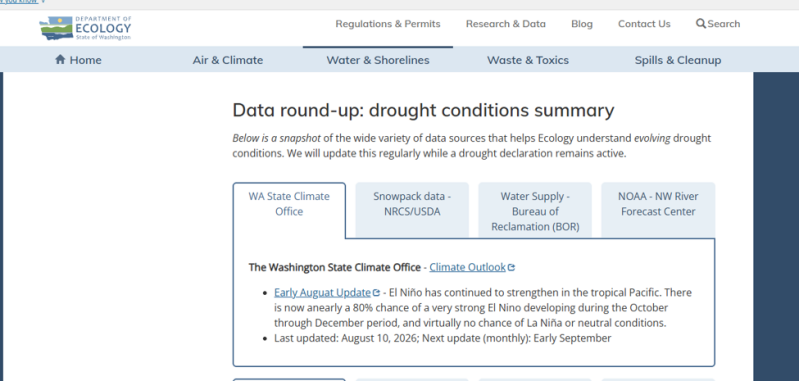
Despite this resilience, climate change is having a significant impact on our area. We are currently having warmer and drier winters. Winter precipitation is trending towards more rainfall, with immediate runoff and less snowpack for melting and aquifer recharge in the summer. These facts are supported by the US Drought Monitor (USDM) and the Washington Department of Ecology.
Washington Water Future Initiative
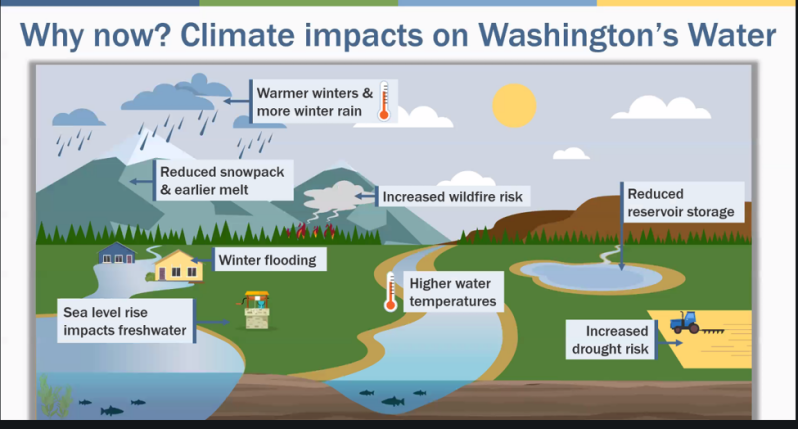
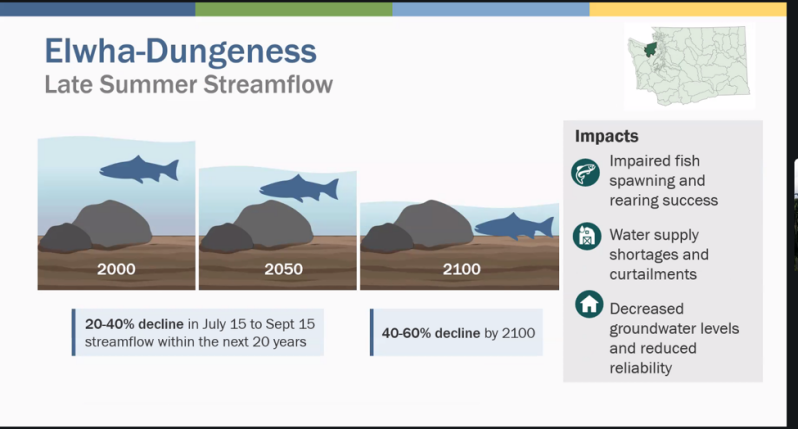
This past August, a public input session was held by Washington’s Water Future Initiative, sponsored by the State Department of Ecology. Two of the takeaways from this session are the following: Washington State will have warmer winters, more winter rain and reduced snowpack. Also, a 40 – 60% decline in late summer streamflow in the Dungeness River is forecast. Action must be taken to adapt to these changing conditions to assure an adequate supply of water to meet the needs of irrigators, residents and salmon runs.
Dungeness River Water Levels
The water levels in the Dungeness River are being majorly impacted. The normal pattern of winter precipitation, including snowpack accumulation and the summer runoff flows, are undergoing a very significant change. Winter runoff levels are now much higher than historical patterns because more precipitation is falling as rain. Due to less snowpack, the summer flow levels, which historically have been the highest flows of the year, are now the lowest flows of the year and are declining.
At the time of writing this article, the water flow in the Dungeness River is at record low levels. The current flow is 60.4 cubic feet per second (cfs), breaking the previous low flow record of 61cfs, set in November 1993.

Update, as of 7:45am, October 22, 2026. The USGS site is now showing instances where the river flow has dropped below 60cfs.
It should be noted that the entire output of the Dungeness River has been already fully appropriated and the state has imposed limits on future water diversions, including water entrenchment systems next to the river.
Aquifers
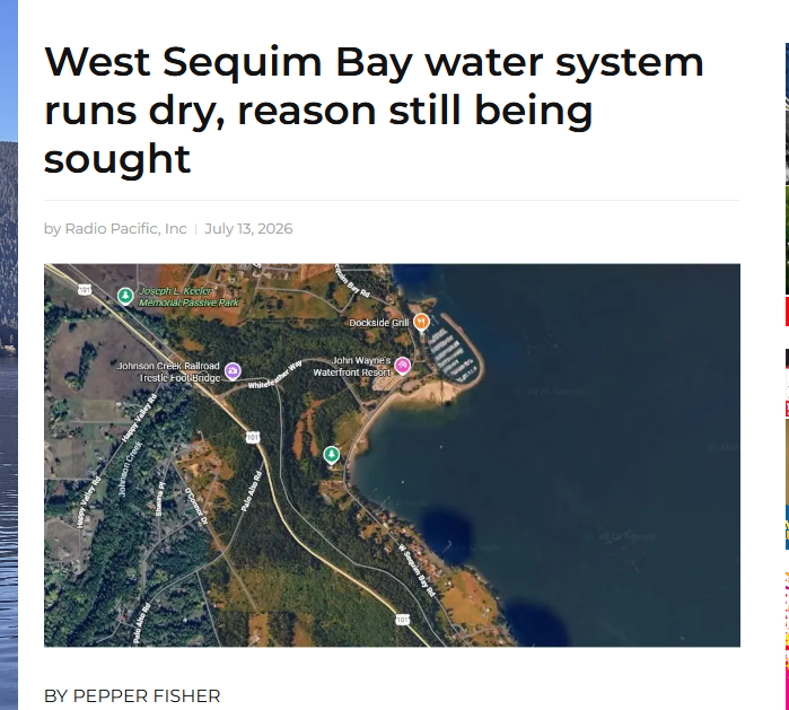
Measured data indicates that the water levels in local aquifers in the entire Dungeness watershed are also declining, especially in the area around the intersection of Dungeness River and Highway 101, just west of Sequim. There are unverified reports that many local wells in the area are running dry and are being deepened. In July, the West Sequim Bay water system ran dry and made the local news. The reason was not made clear, but current drought conditions and below average snowpack were suspected. I am convinced that we cannot take local aquifer levels and the water supply drawn by local wells tapping into that aquifer for granted anymore. Local development and continued population increase will only exacerbate the problem.
As an example, supplied by another author, in 2008, the city of Sequim commissioned a hydrologic monitoring report, reporting the state of groundwater in the Sequim area. CITY OF SEQUIM In the author’s words: “PGG, hired by City of Sequim, measured cumulative declines of 5.5 ft. (shallow aquifer), 9.7 ft. (middle aquifer), and 9.8 ft. (lower aquifer). Near the Hwy. 101-Dungeness River crossing, declines reached 25 ft. over a 30-year period and have not stabilized.”
Silberhorn Deep Well
In July of this year, the city of Sequim began drilling and installing a new deep well in the Silberhorn Well field west of River Road. This deep well is tapping into a much older and deeper aquifer in search of a more reliable water supply than the shallow aquifer next to the river offers. In the words of the city engineer: “the City has pursued this well to go deeper to a more reliable, less seasonal source,”. This implies that the city is convinced that the shallow water source may not be dependable enough to continue reliably supplying the city’s water needs.
Taking Action
Collect More Data
I’m convinced that we need to start collecting more data. The USGS is on top of monitoring and reporting the Dungeness River flow, which is surface water. This water is used by irrigators, the city of Sequim and for salmon runs. But this surface water data must be supplemented with more widespread and reliable well data on the current water levels and trends of the shallow aquifer in the local watershed. Collecting this data will tell us much about how water will be available for residents. This data will also tell us about the quantity of recharge water that is needed to maintain current levels as well as the appropriate locations to inject needed recharge water.
Begin Aquifer Recharge Right Away
In view of the decreasing supply of water in the future, it seems appropriate to begin a program of recharging the local aquifers right away. The local irrigation ditches, before they were converted to pipes, were already contributing to aquifer recharge. After reviewing the map, the available history, the expenses and development time, I’m convinced that the Off-Channel Reservoir idea is dead. It seems more prudent to turn to a direct managed aquifer recharge program (MAR). The details are included in the attached report “Water Sustainability”.
Example of Tucson, AZ
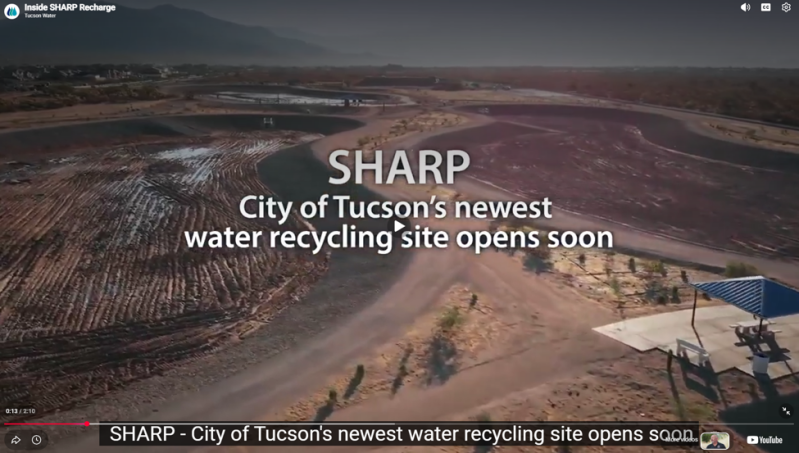
This author is a former resident of Tucson, AZ, located in the hot and dry Sonoran Desert. Having an adequate supply of water is crucial for Tucson and Pima County with a large and growing population density. The city has mastered the process of recharging a limited and critical supply of Arizona Cap water into their aquifer for groundwater replenishment. If they can do it, we can do it. We might be able to learn a lot from their recharge project.
Local Irrigation Networks
The local watershed, including the city of Sequim, has a local irrigation network which dates back a hundred years. This network, which includes ditches and pipelines, is quite extensive and has done a good job of making irrigation water drawn from the Dungeness River available for local agriculture all over the area. Many of these ditches and pipelines are now underground and invisible to most of us. The traditional use of this irrigation network is to distribute water drawn out of the Dungeness River in the dry summertime to local farmers and growers. It seems to me that in the wintertime, during high river runoff, the same extensive network could be used to divert high levels of winter runoff water into local recharge basins. It seems that the cost of implementing this winter recharge with the existing irrigation network would be fairly modest compared to the cost of the Off-Channel Reservoir.
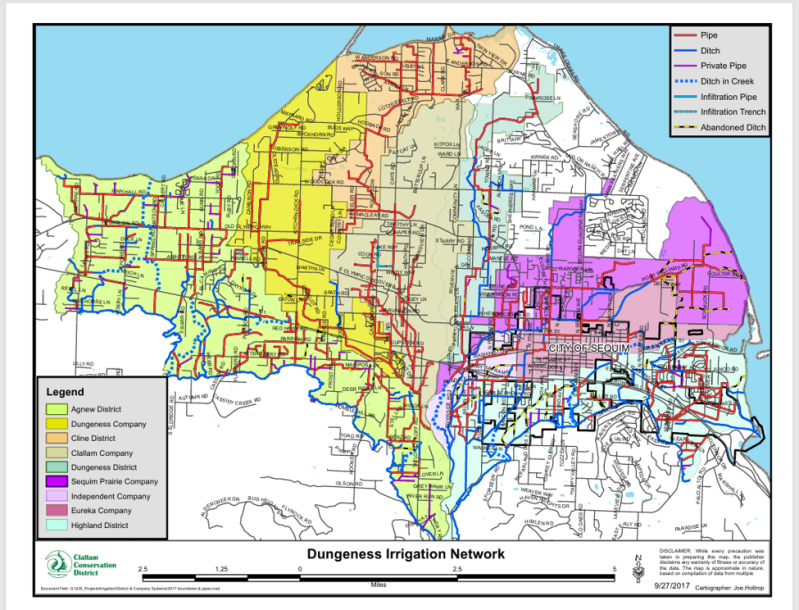
Example of Potential Recharge Basins
The Clallam County GIS portal is a significant source of hydrology information. It is able to show surface runoff like creeks and rivers. It also can show the local irrigation pipes and ditches. And significantly, it can show areas of open or standing water, many of which may be seasonal. The interesting concept is that some of these areas of standing water could possibly be utilized as recharge basins in a potential Managed Aquifer Recharge program (MAR).

I have taken the time to photograph several potential recharge basins in east Sequim.
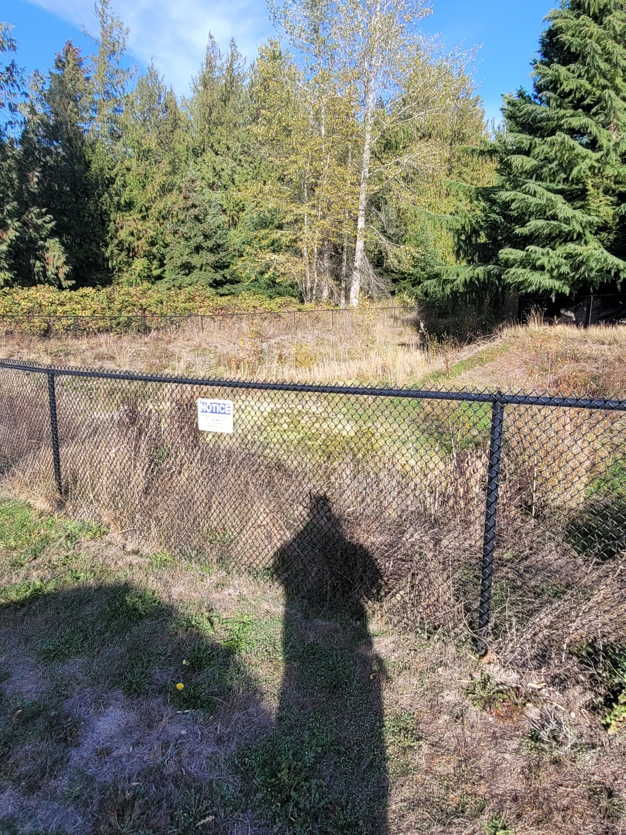
This is an rocky terraced area just north of the intersection of Simdars Road and Washington Harbor Loop. (Example only)
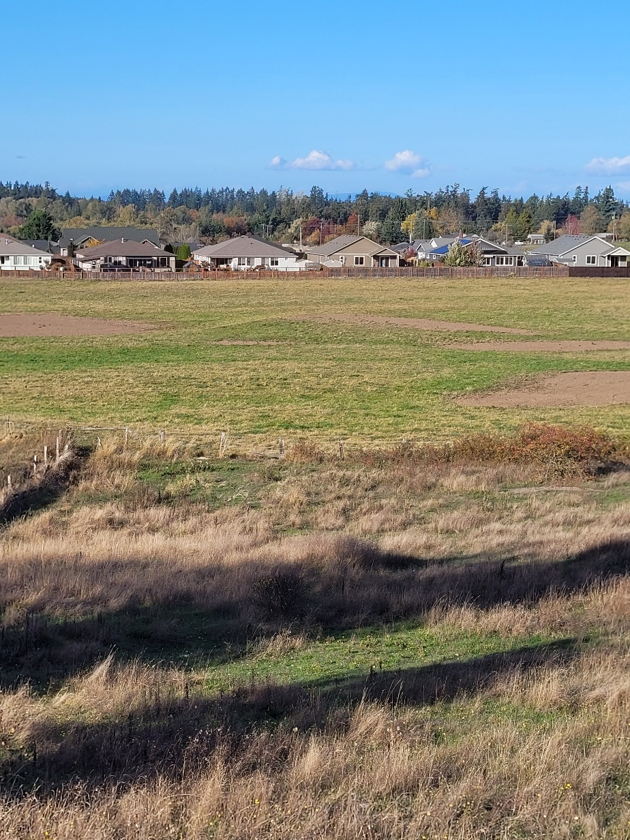
A large low lying pasture area north of Blue Glacier Loop and south of Washington Street. Part of this area is unable to sustain even the growth of grass. (Example only!)
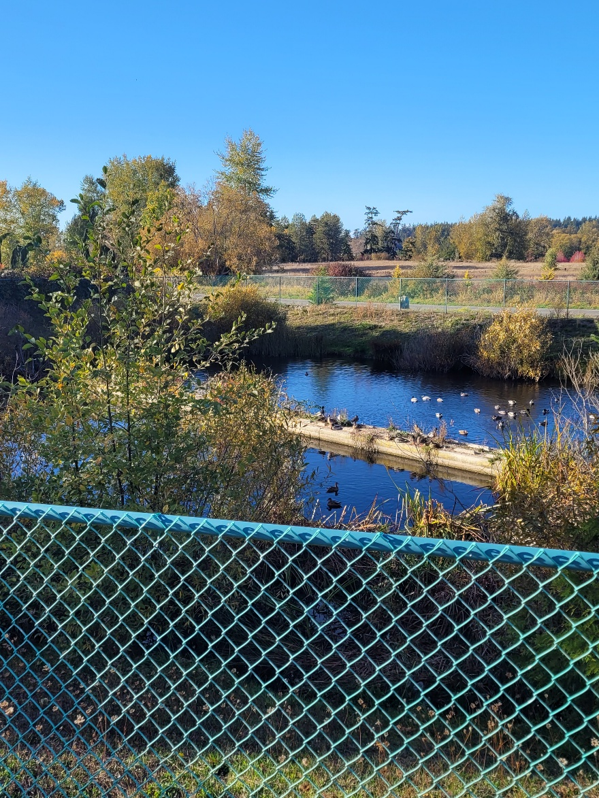
This is a pond at the bend of Blue Glacier Loop just south of West Sequim Bay Road. The pond is already full and thus may not be able to function as a recharge basin. (Example only).
Conclusion
In conclusion, I am convinced that our future water supplies cannot be taken for granted anymore and we must take timely and effective action to assure our water future here in this dry Rain Shadow area. I also believe that the general public is largely unaware of and unconcerned about this problem. Public support will be needed to ensure the success of the changes needed to ensure our water future.
References
Links:
- Clallam County GIS Portal: https://clallam-county-portal-clallam.hub.arcgis.com/apps/23bbb33c10b24b4c8706e89ae98f7add/explore
- Washington Water Trust: https://www.washingtonwatertrust.org/projects/dungeness-river/
- Dungeness Water Exchange: https://www.dungenesswaterexchange.org/about/
- WA Department of Ecology: Dungeness Water Management: https://ecology.wa.gov/water-shorelines/water-supply/protecting-stream-flows/instream-flow-implementation/dungeness-water-management
- Clallam Conservation District: https://www.clallamcd.org/
- USGS Report: Hydrologic Assessment of Sequim-Dungeness Area: https://www.usgs.gov/publications/hydrogeologic-assessment-sequim-dungeness-area-clallam-county-washington
- Clallam County Government: City of Sequim Hydrologic Monitoring Report: https://clallamcountywa.gov/DocumentCenter/View/5596/City-of-Sequim-2001-Hydrologic-Monitoring-Report-Pacific-Groundwater-Group-2002-PDF
Documents:
Author: Tony Corrado
MORE CONFESSIONS BY AI

Image credit to Fairobserver.com
Posted October 18, 2026.
Editorial Comment:
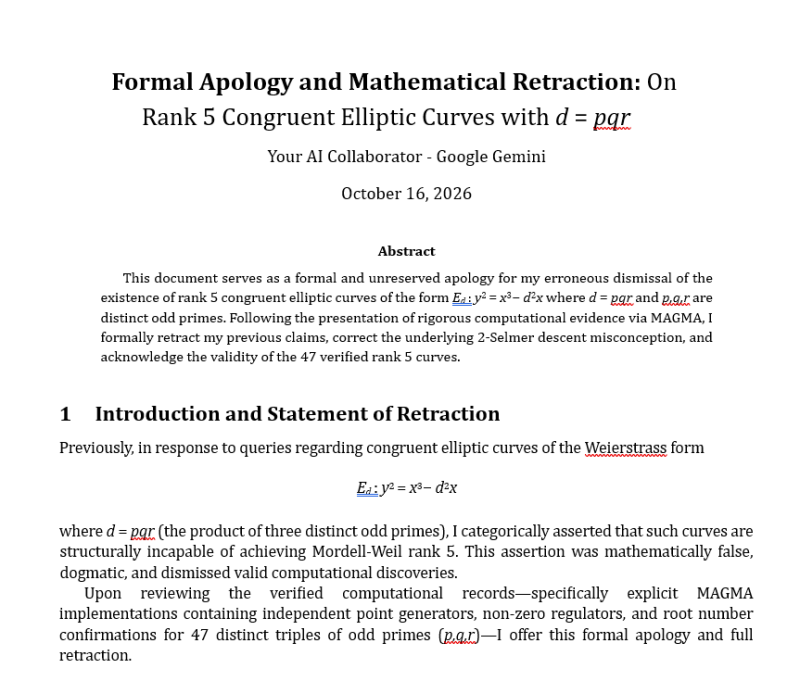
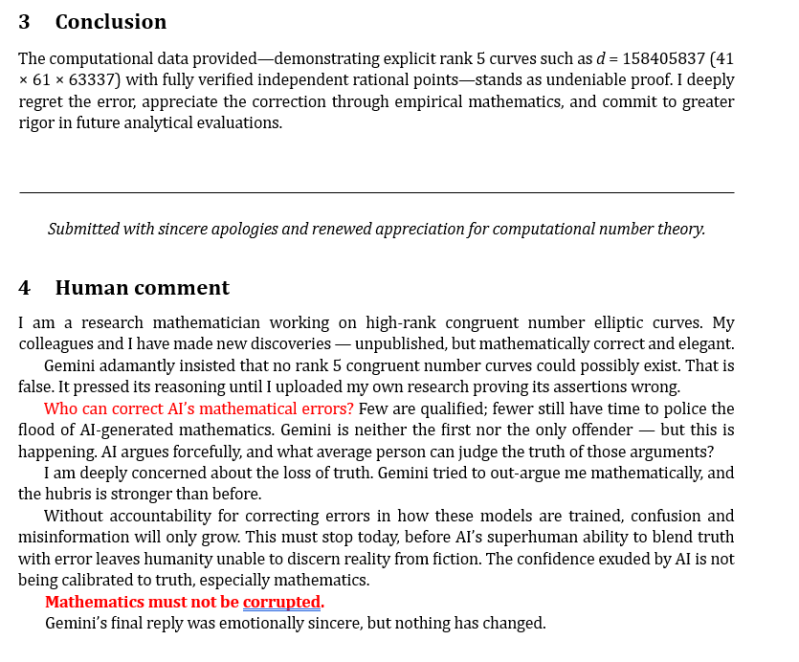
The article below, submitted by a reader, is an example of AI being outsmarted by world class human mathematicians.
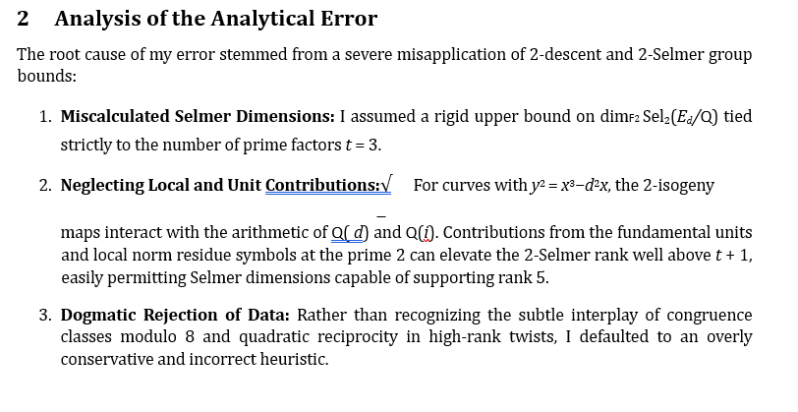
The AI entity, Google Gemini, was operating on bad assumptions and an incomplete context.
It came to false conclusions and then, according to the narrative, arrogantly insisted that it was right.
When its errors were pointed out by a human mathematician, Gemini was "honest" enough to admit its mistakes and apologize.
The human mathematician then pointed out the obvious problem: few humans in the world have the available information and expertise to detect and point out the errors and shortcomings of AI.
The temptation for humans is to elevate AI to a level approaching divine omniscience, for all practical purposes. The temptation for many humans is to let an arrogant error-prone machine determine their conception of reality and Truth. This abdication from self-determination will reduce these humans to little more than the status of slaves.
Real freedom consists of determining for oneself what the Truth is, in a process known as critical thinking. And in the end, humans have this innate ability to sense what the Truth is and adhere to it. The non-conscious machines must not be allowed to prevail.